
Cybersecurity awareness training is all about turning your staff from a potential weak link into your strongest defence against online threats. Think of it as an ongoing educational process that teaches your team how to spot, sidestep, and report cyberattacks like phishing, malware, and social engineering.
Why Your Team Is Your First Line of Defence
Picture your Kiwi business as a fortress. You’ve got strong walls (firewalls), secure gates (passwords), and even surveillance cameras (security software). But what happens if a smooth-talking trickster simply convinces one of your guards to open the main gate for them? That’s the reality of cyber threats in New Zealand today.
Technology alone just isn't enough anymore. Cybercriminals know this, which is why they’ve shifted their focus to the most accessible—and often most vulnerable—part of any business: its people. The human element is consistently the weak spot attackers love to exploit.
The Human Factor in Cyber Attacks
Phishing emails, scammy text messages, and deceptive phone calls don't bother trying to smash through your digital walls. Instead, they’re designed to manipulate your employees into willingly handing over the keys.
It could be an urgent-sounding email pretending to be from a supplier, a fake login page for a familiar service, or a seemingly innocent attachment. All of these are common entry points for attackers.
When a team member clicks a dodgy link, they can accidentally unleash ransomware that locks up your entire network. If they're tricked into paying a fake invoice, the financial hit can be instant and devastating. Every single employee, from the front desk to the boardroom, is a potential gateway to your business's sensitive data.
This is precisely why cybersecurity awareness training is so critical. It shifts security from being just an "IT problem" to a shared, company-wide responsibility.
A recent survey from CERT NZ and TRA found that a staggering 62% of New Zealanders reported experiencing an online security attack in the last six months. What's more, only 54% felt confident about their cybersecurity, which really highlights the gap in education.
A Shift in Perspective
Good training completely reframes how your team sees security threats. It stops being some technical issue they can ignore and becomes a practical skill they can use every single day. This creates a powerful human firewall that technology alone can't replicate.
When your staff are trained to be sceptical, cautious, and proactive, they become your single greatest security asset.
This proactive mindset is essential for protecting your company’s finances, reputation, and the integrity of your information. The way you manage and secure company information is also a key part of this defence, which is why understanding proper New Zealand record storage is so beneficial. Ultimately, building this human firewall is the most effective strategy for defending against modern threats here in Aotearoa.
What Effective Training Actually Involves
Let's be clear: truly effective training is much more than a one-off memo warning staff not to click suspicious links. It’s an ongoing programme designed to build practical, real-world skills. For Kiwi businesses, this means moving beyond generic advice and getting into the specific tactics cybercriminals are using right now.
A valuable programme breaks down complex threats into digestible, actionable knowledge. The goal isn't to turn your team into IT experts; it's about empowering them with the confidence to recognise and react to threats correctly. This is the very foundation of a strong security culture.
At its core, good cybersecurity awareness training teaches staff how to spot the wolf in sheep's clothing—starting with phishing emails, which are becoming frighteningly convincing.
Mastering Threat Recognition
Phishing is easily the most common way criminals get their foot in the door. They send deceptive emails to trick people into revealing sensitive information or downloading malware. Your training must cover how to scrutinise emails for red flags, even when they look completely legitimate.
But it doesn't stop there. Spear-phishing is a far more targeted version, where an attacker uses personal information about an employee or the business to make their scam seem more credible. Effective training can equip your team to avoid the most common cybersecurity mistakes and how to prevent them by teaching them to spot these highly personalised attacks.
Key skills your team needs to master include:
- Identifying Phishing Attempts: Learning to spot fake sender addresses, generic greetings, urgent language, and unexpected attachments.
- Recognising Malware Signs: Understanding what happens when a device is infected, like sudden slowdowns, weird pop-ups, or unexpected file changes.
- Safe Web Browsing: Knowing how to verify a website's security and avoid malicious downloads from untrustworthy places.
Building Strong Security Habits
Beyond spotting external threats, effective training instils strong internal security practices. These daily habits are what truly fortify your business from the inside out.
Good password hygiene is a non-negotiable starting point. This means teaching staff not just how to create strong, unique passwords but also how to manage them securely with password managers. It also means stressing the critical importance of multi-factor authentication (MFA).
An effective cybersecurity awareness programme doesn't just inform; it transforms behaviour. It builds a collective sense of responsibility where every team member understands their role in protecting the business's digital assets.
This focus on proactive habits needs to extend to every device your team uses. With more Kiwis working remotely or on the go, securing mobile phones and laptops is absolutely essential.
Essential Modules for Kiwi Businesses
So, what should a complete training programme cover? For any New Zealand business, it needs to address our local context and common workplace scenarios. Here’s a look at the core topics every employee needs to get their head around.
| Training Module | Why It's Critical for NZ Businesses |
|---|---|
| Phishing & Spear-Phishing | The number one threat targeting NZ businesses of all sizes, often leading to financial loss or data breaches. |
| Password Hygiene & MFA | Weak or reused passwords are a primary cause of account takeovers. MFA adds a vital layer of protection. |
| Mobile Device Security | With flexible work common, securing phones and laptops that access company data is essential. |
| Safe Use of Public Wi-Fi | Unsecured networks in cafes or airports are prime spots for attackers to intercept sensitive business information. |
| Data Privacy Obligations | Understanding responsibilities under NZ's Privacy Act 2020 helps prevent accidental data breaches and ensures compliance. |
| Recognising Malware & Ransomware | Empowers staff to identify the early signs of an infection, enabling a faster response to minimise damage. |
These modules form the backbone of a robust defence, turning your team from a potential liability into your greatest security asset.
Building Your Human Firewall
Investing in cybersecurity awareness training isn't just about ticking a compliance box. It’s about fundamentally strengthening your entire organisation from the inside out. When you shift the focus from fear to positive, proactive defence, you'll see a remarkable return.
Think of it this way: your team transforms from a potential vulnerability into your most valuable security asset. When your staff are trained to spot and report threats, they become a collective defence—a powerful human firewall. This is where the real value lies, moving your security posture from reactive to truly proactive.
The Tangible Benefits of Continuous Training
A well-trained team leads to a massive, measurable drop in successful phishing attempts. Untrained employees are easy targets for cybercriminals, but with consistent education, their ability to spot a malicious email improves dramatically. This directly shields your company's bank accounts and sensitive data.
On top of that, a strong training programme reinforces data protection across the board. When your staff understand their responsibilities under New Zealand's Privacy Act 2020, they're far less likely to make small errors that could spiral into a costly data breach. This isn't just about compliance; it builds trust with your clients, showing them their information is in safe hands.
The financial case for this is undeniable. The cost of an ongoing cybersecurity awareness programme is a tiny fraction of the expense and chaos that follows a successful cyberattack.
When you're forced to react to a breach, you're not just dealing with the initial financial loss. You're also facing forensic investigation costs, potential regulatory fines, legal fees, and severe reputational damage that can take years to repair.
A Data-Driven Case for Investment
The numbers paint a very clear picture. Without any security training, an alarming one in three (34.4%) employees in the ANZ region will likely click on a dodgy link or fall for a fraudulent request.
However, organisations that implement regular training and testing see a huge improvement. As you can discover more insights about these cybersecurity trends, the data shows that within the first 90 days of training, this phishing-prone rate drops to 19.1%.
After a full year of continuous training and simulations, the number plummets to just 5.5%. It’s powerful proof of how ongoing education builds muscle memory, turning cautious behaviour into a natural reflex. This is especially critical for smaller NZ businesses, which are often seen as softer targets by attackers.
Ultimately, a trained team is one of the best defences you can have. Of course, it's just one layer of a strong security strategy. It's also vital to understand how a robust backup fights against ransomware and malware, ensuring you can recover quickly if the worst happens. By combining knowledgeable staff with solid technical defences, you create a security posture that’s incredibly tough to break.
How to Implement Your Training Programme
Putting a cybersecurity training programme in place can feel like a massive undertaking, but it doesn't have to be. For New Zealand businesses, breaking it down into a few logical steps is the key to creating something that genuinely sticks. It’s all about moving from theory to practical, real-world action.
This is how you turn your team from a potential weak link into what we call a human firewall—a strong, security-savvy first line of defence.
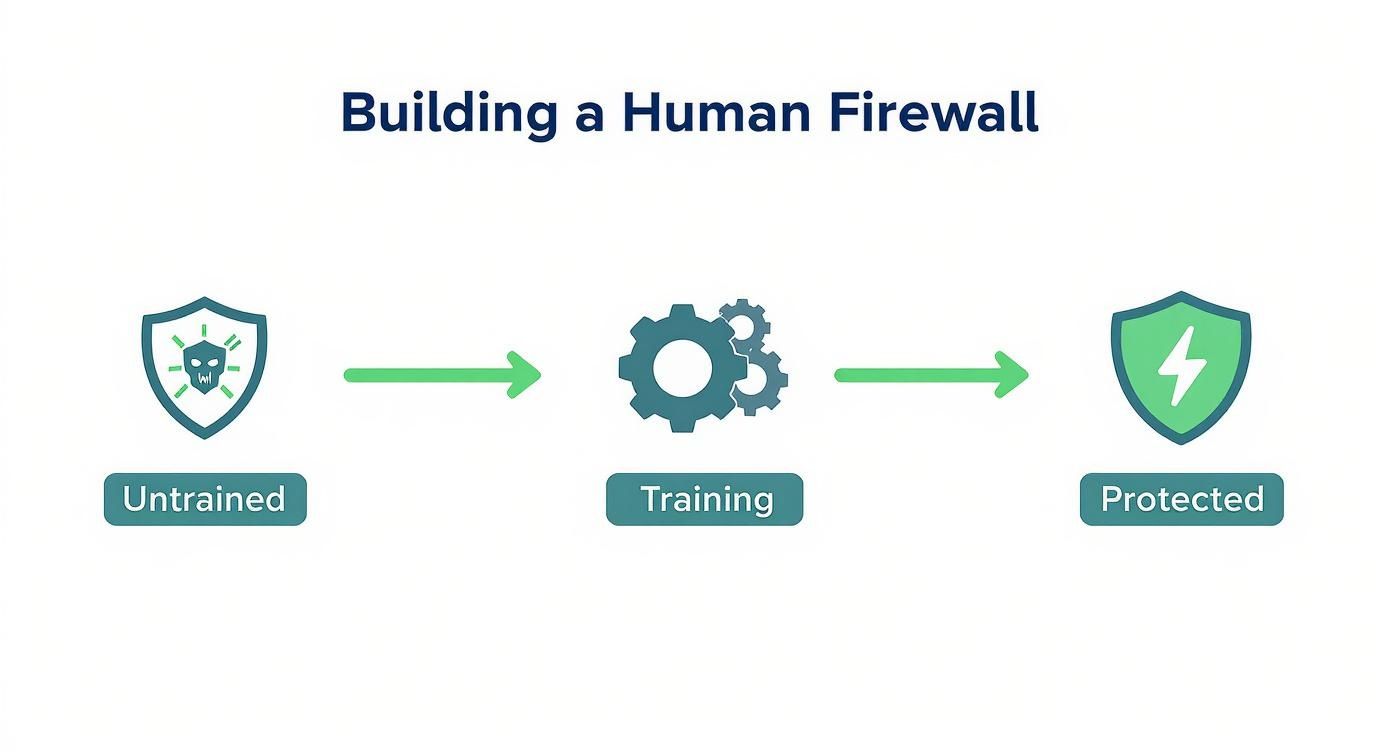
As you can see, the right training takes your people from being vulnerable to becoming a formidable shield, protecting your entire organisation from the inside out.
Step 1: Start with a Baseline Assessment
Before you build anything, you need to know what you're working with. The very first step is to get a clear picture of your team's current cybersecurity knowledge. This isn't about calling anyone out; it’s about finding your biggest risks and knowledge gaps so you can focus your efforts where they matter most.
One of the simplest and most effective ways to do this is with a baseline phishing simulation. You send a safe, simulated phishing email to everyone on staff and see who clicks. The results give you a hard data-backed starting point and make it much easier to tailor the training to your team's specific weaknesses. This kind of data is also brilliant for getting leadership on board.
Step 2: Choose the Right Platform and Content
Once you know where you stand, it's time to pick your training platform. Your goal should be to find a provider offering engaging, bite-sized content that makes sense for Kiwi businesses. Long, dull videos and dense text are a guaranteed recipe for disengagement.
The best training platforms will always have:
- Interactive Modules: Think short videos, quick quizzes, and real-world scenarios that actually hold your team's attention.
- Regular Phishing Simulations: These need to be consistent and automated to keep skills sharp and give you a way to measure improvement.
- NZ-Specific Content: It’s vital to have material that covers local threats and our compliance requirements, like the Privacy Act 2020.
- Clear Reporting: You'll want a dashboard that lets you easily track who has done the training and, most importantly, watch your phishing click-rates go down.
The real aim here is to weave learning into your company culture, not just to tick a box once a year. A good programme feels like a natural part of the workflow, delivering the right information when it's needed.
Step 3: Launch Your Initial Campaign
How you launch the programme sets the tone for everything that follows. Make sure you communicate clearly to your team why this training is important—not just for the business, but for them personally. Frame it as an investment in their skills and a crucial part of keeping everyone safe.
Kick things off with the fundamentals, like how to spot phishing emails and create strong passwords. The training should be mandatory, but the vibe should be positive. Your first campaign is all about empowerment, not punishment.
Step 4: Implement Continuous Learning and Measurement
Cyber threats don't stand still, so your training can't be a one-and-done event. A truly successful programme depends on continuous reinforcement.
Schedule regular phishing simulations—monthly is ideal—to keep your team alert. Back this up with short, timely training modules that tackle new threats as they pop up. It’s also vital to build robust strategies for business continuity and disaster recovery so your operations can handle any incident that comes your way.
And crucially, you have to measure your progress. Keep an eye on key metrics like your phishing simulation click-rate, training completion rates, and how many real threats are being reported by staff. This data doesn't just prove the programme's value; it helps you fine-tune your strategy over time. To dig deeper into this, check out these great insights on creating a training programme that actually works.
Choosing the Right Training Partner in NZ
Not all cybersecurity awareness training platforms are created equal, especially when you’re dealing with the unique challenges Kiwi businesses face. Picking the right partner is a critical step; it’s the difference between a training programme that sticks and one that’s just another chore for your staff to click through.
A generic, one-size-fits-all solution from an overseas company often misses the mark. The best training uses local examples, talks about scams that are actually happening in New Zealand, and understands our business culture. When your team can see themselves in the training scenarios, the lessons really hit home.
What to Look For in a Provider
As you start looking at your options, a few key things separate the average providers from the great ones. You want a platform that feels like a genuine partner in your security journey, not just another piece of software you have to manage.
Keep an eye out for a provider that offers:
- Engaging and Relevant Content: The training has to be interesting. Short, interactive modules that use real-world Kiwi examples are far more powerful than long, dry presentations.
- Regular Threat Updates: The cyber threat landscape is always shifting. Your provider needs to be on top of the latest phishing tactics and scams targeting New Zealanders and update their content to match.
- Realistic Phishing Simulations: There’s no substitute for practice. A good partner will offer regular, automated phishing tests that look just like the real threats your team will inevitably face.
A Local Partner for Kiwi Businesses
At Backup, we get the New Zealand business environment because we’re part of it. We’re a Christchurch-based company providing nationwide backup and security solutions designed specifically for businesses like yours. We’re firm believers that world-class cybersecurity shouldn't be complicated or out of reach for anyone.
Our cybersecurity awareness training is built from the ground up for the NZ market. Our focus is on making security simple, accessible, and incredibly effective.
We believe that every Kiwi business, regardless of its size, deserves a strong defence against cyber threats. Our approach is to empower your team with practical skills, turning them into your most reliable security asset.
Simple Pricing for Every Business
We like to keep our pricing straightforward and transparent, so you can easily find a plan that fits your budget without any hidden surprises. Good security is a necessity, and our goal is to make it affordable for every NZ business.
Here's a look at our simple, no-fuss plans for cybersecurity training.
Backup Cybersecurity Training Plans
Simple, transparent pricing for New Zealand businesses of all sizes. All prices are in NZD.
| Plan Name | Monthly Price |
|---|---|
| Business 10 | $30 per month |
| Business 20 | $50 per month |
| Business 50 | $100 per month |
| Business 100 | $150 per month |
We've made it easy to get started and see just how effective locally-focused training can be.
Ready to see the difference for yourself? We invite you to experience our platform firsthand. You can start a no-obligation 14-day trial today to explore all our features and begin building your human firewall.
Your Staff Security Training Questions Answered
Even when you know how important security training is, getting started can feel a bit daunting. It’s a space filled with jargon and ever-changing threats, so it’s completely normal to have questions. We get it.
To help clear things up, we've gathered the most common questions we hear from Kiwi business owners just like you. Getting these answers sorted is the first real step to building a strong, security-first culture in your team.
How Often Should We Be Doing This Training?
This is probably the most critical question, and the answer is simple: training has to be an ongoing thing, not a one-off event.
Think of it like a fire drill. You wouldn't run one drill and just assume everyone will remember what to do five years down the track. Security skills are the same—they need regular practice to stay sharp and effective.
The best approach involves a few key stages:
- Day One Onboarding: Every new person who joins your team should get a solid security briefing as part of their induction. This sets the standard right from the beginning.
- Regular Top-Ups: Short, sharp refresher modules should be rolled out monthly or quarterly. This keeps security front-of-mind without bogging everyone down.
- Practice Runs: This is the most important part. All the learning needs to be backed up by regular simulated phishing tests. These practical exercises are the only real way to see if the lessons are sticking and to spot who might need a bit of extra coaching.
The aim is to build a lasting security mindset, not just to tick an annual compliance box.
Is This Really Necessary for a Small Business Like Ours?
Absolutely. In fact, you could argue it’s even more important for smaller businesses.
Cybercriminals often see small to medium businesses (SMEs) as easy targets. They assume you don’t have the big, flashy security systems that large corporations do, and they know that one successful attack can do a lot more damage.
A single breach—like a ransomware attack that locks up all your files or a convincing fake invoice that gets paid—can be financially crippling for a small business. Your people are your first and most important line of defence. Giving them quality cybersecurity awareness training is one of the smartest, most cost-effective investments you can make to protect your data, your money, and your hard-earned reputation.
What's the Real Difference Between 'Awareness' and 'Training'?
This is a great question, and the distinction is one that often gets missed. The two ideas are linked, but they do very different jobs.
Awareness is knowing that threats like phishing are out there. Training is having the practical skills to know what to do when one lands in your inbox.
An "awareness" campaign might be putting up a poster in the lunchroom. It’s helpful, but it’s passive. A proper training programme, on the other hand, is active and hands-on. It teaches your team how to spot the subtle red flags in a dodgy email, what goes into a genuinely strong password, and exactly who to call and what to do if they think something is wrong.
A good programme will always blend both, making sure your team doesn’t just know about the risks but feels empowered to act correctly when faced with them.
How Can We Measure the ROI of This Training?
You need to justify every dollar you spend, and security training is no different. Luckily, its impact is surprisingly easy to measure.
The most direct and powerful metric is the click-rate from your simulated phishing tests. As your training programme beds in, you should see this number drop—a lot. That’s hard data right there, proving your team is getting better at spotting threats.
Other ways to track success include:
- Fewer actual security incidents being reported to your IT support.
- A drop in malware infections on company computers.
- Better scores on quizzes and knowledge checks within the training modules.
But the true ROI comes from weighing the small, predictable cost of a training programme against the massive, unpredictable cost of a single data breach. When you think about the financial loss, potential fines, and long-term damage to your reputation, proactive training is always the better bet.
Ready to turn your team into your strongest security asset? At Backup, our Christchurch-based team provides nationwide cybersecurity awareness training designed specifically for Kiwi businesses. Start building your human firewall today.
Explore our simple, affordable plans and begin a free 14-day trial.