
Protecting your data isn't just about stopping hackers from breaking in; it's also about preventing sensitive information from walking out the front door. That's the core of data leakage protection: building strong defences to stop your company's private data from being accidentally exposed or deliberately stolen.
For most Kiwi businesses, this means locking down everything from client files and financial records to internal strategy documents, making sure they never leave your control—whether it's through a simple email mistake or a targeted attack.
The Growing Risk of Data Leaks for Kiwi Businesses
Think of all your client files as being stored in a digital filing cabinet. Data leakage is what happens when the lock on that cabinet breaks, spilling sensitive information out into the open. This isn't just a headache for massive corporations; it's a real and growing threat for New Zealand businesses of all shapes and sizes.

If you're in professional services—an accounting firm, a law practice, or a marketing agency—the risk is especially high. You're sitting on a goldmine of client data, from financial statements to personal details, which makes your business a very attractive target for cybercriminals.
Why a Proactive Defence Matters
It’s easy to think a data leak is something that only happens to other people. The hard truth is that overlooked vulnerabilities are everywhere. A single misconfigured setting, one convincing phishing email, or a misplaced laptop can be all it takes to trigger a catastrophic data leak.
The fallout goes far beyond the initial incident. You could be facing hefty financial penalties, serious damage to your reputation, and a permanent loss of the trust you’ve worked so hard to build with your clients.
Putting strong defences in place is always more effective—and far less costly—than dealing with the aftermath of a breach. Proactive data leakage protection is no longer a 'nice-to-have'; it's a core business necessity.
This guide will show you why a forward-thinking approach is so crucial. A solid defence strategy isn't just about software; it’s about having the right policies, training your team, and having a bulletproof recovery plan ready to go. These pieces work together to form a layered shield around your most valuable asset: your data. A great place to start building this shield is by understanding the basics of business continuity and disaster recovery.
Your Trusted Local Partner
As a Christchurch-based company, Backup offers nationwide backup and security services designed from the ground up for Kiwi businesses. We get the local landscape and the unique challenges you face. Our mission is simple: make robust data protection straightforward and accessible.
We offer clear, affordable plans to secure your operations:
- Business 10: $30 per month
- Business 20: $50 per month
- Business 50: $100 per month
- Business 100: $150 per month
Protecting your business doesn’t need to be complicated or break the bank. See for yourself how easy it is to implement powerful data leakage protection—start a 14-day free trial today.
How Does Business Data Actually Leak?
When you picture a data leak, it’s easy to imagine a shadowy hacker launching some complex, Hollywood-style attack. But the reality is often far more mundane. More often than not, a serious data leak starts with a simple, everyday mistake—a moment of carelessness that accidentally opens a door to your sensitive information.
To build a defence that actually works, you first need to understand the different ways your data can slip through the cracks. They generally fall into two main camps: accidental and malicious. One is an honest mistake, the other is deliberate, but both can be devastating for your business.
Accidental Leaks: The Unintentional Slip-Ups
Accidental leaks are alarmingly common and usually spring from routine business activities. These are the human errors that can happen in even the most diligent teams, proving just how easily a small oversight can spiral into a major security incident.
Think about these everyday scenarios that Kiwi businesses face all the time:
- Email Mistakes: An employee means to send a spreadsheet with client financials to "John Smith" but autofill sends it to "John Smyth" outside the company instead. It's a one-click mistake.
- Lost or Stolen Devices: A staff member leaves their company laptop in a cafe or has their work phone stolen from their car. If that device isn't encrypted, all the client files on it are wide open.
- Misconfigured Cloud Settings: Someone in your team creates a shared folder in your cloud storage but accidentally sets it to 'public' instead of 'private'. Now, anyone with the link can access those confidential documents.
- Improper Disposal: An old office computer or hard drive is thrown out without being professionally wiped, leaving years of recoverable client records for anyone to find.
These incidents aren’t driven by bad intentions. They're the result of a gap in a process, a lack of awareness, or just a momentary lapse in concentration. The consequences, however, are just as severe as a targeted cyberattack.
Malicious Leaks: The Deliberate Threats
While accidents are a huge risk, malicious leaks are a more calculated threat. These are intentional acts by people who want to steal or expose your data for personal gain, revenge, or financial profit. These threats can come from outside and inside your organisation.
External threats are what most people think of—outsiders trying to break in.
- Phishing Emails: A cybercriminal sends a cleverly disguised email that tricks a staff member into revealing their login password, handing over the keys to your network.
- Malware and Ransomware: An employee clicks on a dodgy link in an email, unknowingly installing software that quietly steals data in the background or locks up all your files until a ransom is paid.
Internal threats, however, can be even more damaging. Why? Because these individuals already have legitimate access to your sensitive information.
- Disgruntled Employees: A staff member leaving on bad terms decides to download the entire client list or your latest product designs to take to their new job at a competitor.
- Corporate Espionage: It sounds dramatic, but it happens. An employee could be paid by a rival company to deliberately leak trade secrets, marketing plans, or financial projections.
The reality is, your business data is vulnerable from both inside and outside your organisation. A solid security plan has to account for the well-meaning employee who makes a mistake and the malicious actor looking to cause harm.
Once you understand these real-world scenarios, it’s clear that weaknesses exist in both your technology and your daily processes. That’s why a complete defence is so critical. For Kiwi businesses, the first step is recognising the risk. The next is taking action with a trusted local partner.
As a Christchurch-based company, Backup offers nationwide security to protect against these very threats. Our plans are designed to be affordable for any New Zealand business:
- Business 10: $30 per month
- Business 20: $50 per month
- Business 50: $100 per month
- Business 100: $150 per month
Ready to see how simple and effective data leakage protection can be? You can explore our solutions and start a 14-day free trial to experience it firsthand.
The True Cost of a Data Breach in New Zealand
When a data leak hits, it’s all too easy to get tunnel-vision on the immediate technical mess. But the real damage spreads far wider than a compromised server or a misplaced laptop. For any Kiwi business, a data breach isn't just an IT headache; it's a full-blown financial and reputational crisis that can spiral out of control with terrifying speed.
The financial fallout is usually the first punch. Under New Zealand's Privacy Act, failing to protect personal information can lead to hefty fines. Then come the other costs: hiring forensic investigators to piece together what happened, notifying every affected client, and maybe even footing the bill for credit monitoring services.
But those direct costs are just the start. The deeper, more lasting damage often comes from the fallout you can't see on a balance sheet, crippling a business for years to come.
The Immediate Financial Fallout
The direct monetary losses from a data leak can stack up incredibly quickly. For a start, there's the operational downtime. Your team's focus instantly shifts from productive work to damage control, and every hour your business is offline is an hour of lost revenue. Productivity grinds to a halt while you scramble to investigate, contain the damage, and get back to normal.
Recent numbers paint a grim picture for local businesses. In the first quarter of 2025 alone, cyber incidents in New Zealand led to documented financial losses of NZD $7.8 million. That’s a 14.7% increase from the previous quarter, proving that these financial risks aren't just real—they're growing fast. You can dive into the full report and learn more about these NZ cyber security insights.
Beyond the Balance Sheet: Reputational Damage
For any professional services firm, trust is your most valuable asset. A data breach shatters it in an instant. Clients who have handed over their most sensitive financial, legal, or personal information will rightly ask if they can ever rely on you again.
The erosion of client trust is often the most devastating consequence of a data leak. Rebuilding a reputation that took years to establish can be an uphill battle, and some client relationships may never be recovered.
This loss of confidence creates a ripple effect. Bad news travels fast, and the negative publicity around a breach can permanently tarnish your brand. Trying to attract new clients becomes incredibly difficult when a quick online search brings up a history of security failures.
The infographic below shows just how easily these costly events can happen, highlighting the split between accidental slip-ups and malicious attacks.
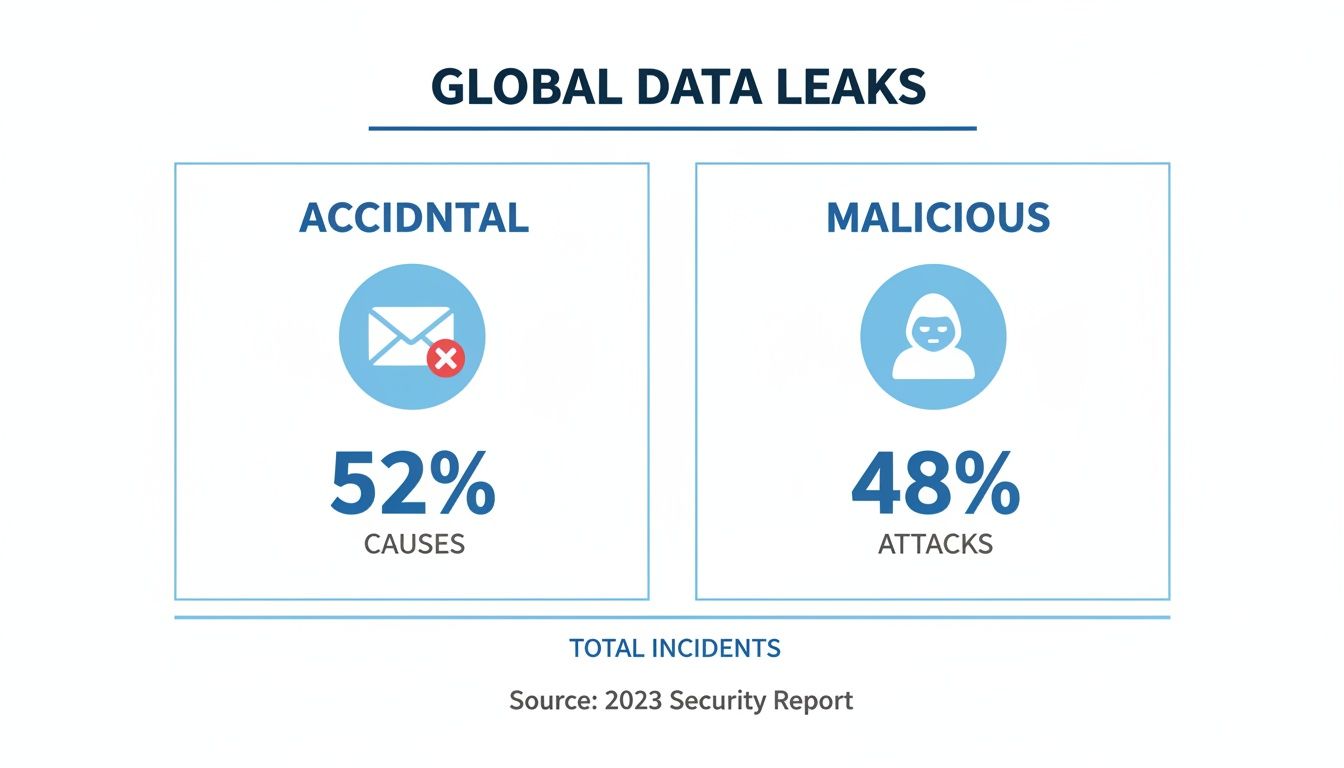
With the threat split almost down the middle, it’s clear that a solid defence has to cover both internal mistakes and external attacks.
Ultimately, the true cost of a data breach is the hard-earned lesson that prevention is always cheaper than the cure. The investment in robust data leakage protection is a fraction of the expense and heartache involved in cleaning up the aftermath. For Kiwi businesses, the choice is clear: proactive security isn't just an expense; it's an essential investment in your survival.
Practical Strategies for Data Leakage Protection
Knowing the risks is one thing, but building a solid defence requires a practical, multi-layered approach. Effective data leakage protection isn't about finding a single magic bullet; it's about creating a series of overlapping safeguards that protect your business from both honest mistakes and targeted attacks.
These strategies are all manageable, actionable, and designed for any New Zealand business ready to get serious about securing its data.
The goal is to build a security posture where one small slip-up doesn’t spiral into a catastrophe. Each layer works together, from your company policies and staff training right through to the technology you put in place.
Develop Clear Data Handling Policies
Your first line of defence is making sure everyone on your team knows the rules. A clear, straightforward data handling policy removes the guesswork and sets a consistent standard for how sensitive information is managed day-to-day.
This doesn't need to be a hundred-page legal tome. It should give simple guidance on crucial activities.
- Data Classification: Clearly define what counts as sensitive data—client financial records, personal details, internal strategy documents—so your team knows exactly what needs extra protection.
- Acceptable Use: Outline the rules for using company devices, networks, and email. Can staff use personal cloud storage for work files? Are USB drives permitted? Be specific.
- Remote Work Security: Set clear expectations for securing home networks and company laptops when your team is working outside the office.
Implement Regular Security Training
Even the best policies are useless if your team isn’t aware of them or the real-world threats they face. Regular, engaging security training is essential for turning your staff from a potential weak link into your greatest security asset. It's how you build a human firewall.
A well-trained team is your most effective defence against common threats like phishing. When your staff can spot a suspicious email, they can stop an attack before it even begins.
Training needs to be an ongoing conversation, not a one-off event. New Zealand organisations are seeing a sharp rise in threats; during the first quarter of 2025, there were 73 reported cases of unauthorised data copying and IP theft, a 33% jump from the previous quarter. Many of these breaches happened because of basic security oversights, highlighting just how crucial vigilance is.
Effective training turns abstract threats into recognisable, real-world scenarios, helping your team build practical security habits. To see what this looks like in practice, you can explore our resources on cybersecurity awareness training for more guidance.
Enforce Strict Access Controls
A core principle of data security is the Principle of Least Privilege. Put simply, this means employees should only have access to the specific data and systems they absolutely need to do their job—and nothing more.
Think of it like a digital keycard system. Someone in marketing doesn't need access to accounting's payroll files, and an accountant has no need to see the next marketing campaign strategy. By limiting access, you drastically reduce the potential damage if an employee's account is ever compromised.
Use Essential Technological Safeguards
Finally, you need the right technology working in the background to enforce your policies and protect your data 24/7. These aren't optional extras; they're foundational.
- Encryption: This process scrambles your data, making it completely unreadable to anyone without the correct digital key. All sensitive data should be encrypted, both when it's stored on your servers (at rest) and when it's being sent over the internet (in transit).
- Endpoint Security: This is all about protecting every device that connects to your network—laptops, phones, and tablets. Modern endpoint security software helps block malware and can remotely wipe a device if it's lost or stolen, stopping a minor incident from becoming a major breach.
Key Data Leakage Protection Strategies
To tie it all together, here's a quick summary of the core strategies every business should have on its radar. Think of these as the pillars of a strong data protection plan.
| Strategy Area | Key Actions | Why It's Important |
|---|---|---|
| Policy & Governance | Develop clear data handling policies, classify data by sensitivity, and establish rules for device usage. | Creates a consistent security standard across the entire organisation, removing ambiguity for staff. |
| People & Training | Implement ongoing cybersecurity awareness training that covers phishing, social engineering, and secure practices. | Empowers employees to become the first line of defence by recognising and reporting threats. |
| Access Control | Enforce the Principle of Least Privilege, use multi-factor authentication (MFA), and conduct regular access reviews. | Ensures that even if an account is compromised, the potential damage is contained and minimised. |
| Technology & Tools | Use encryption for data at rest and in transit, deploy endpoint security, and implement network monitoring. | Provides automated, round-the-clock protection that enforces policies and detects suspicious activity. |
These strategies, when working in concert, create a formidable defence for your business.
Beyond these preventative measures, it's absolutely critical to develop a robust data breach response plan. Having this ensures your team knows exactly how to act swiftly and effectively if a security incident does occur.
How Automated Backups Strengthen Your Defences
Thinking of backups as just a recovery tool is an outdated view. A modern, automated backup service is a powerful and active part of your data leakage protection strategy—acting as a frontline shield, not just an insurance policy for when things go wrong. It’s all about proactive defence, not just reactive recovery.

As a Christchurch-based company providing nationwide support, Backup has designed its service to be a core pillar of your security. It works around the clock to safeguard your live data, turning your backup system into a proactive security measure that actively strengthens your defences.
Encryption as a Digital Vault
One of the most powerful features of a modern backup solution is end-to-end encryption. Think of it as placing your data inside a digital vault before it even leaves your office. This process scrambles your information, making it completely unreadable to anyone without the correct key.
This protection is crucial at two critical stages:
- In Transit: While your data is travelling over the internet to our secure datacentres.
- At Rest: While your data is stored on our servers.
Even if an unauthorised party managed to intercept your data, they would only get a jumble of nonsensical characters. This single layer of defence can be the difference between a minor incident and a catastrophic data leak.
A Proactive Defence Against Threats
Beyond simply copying files, a robust backup service actively monitors for threats. For instance, Backup’s solution includes continuous scanning and built-in ransomware detection. This system is always on the lookout for suspicious activity, like the rapid, unauthorised encryption of files that signals a ransomware attack.
By spotting these threats early, the system can help stop an attack in its tracks before significant data can be stolen or compromised. It turns your backup from a passive archive into an active security sentry, constantly guarding your digital assets. This is a crucial element of any strong plan for cloud backup for business security.
Secure, Local Data Storage
For New Zealand businesses, knowing where your data is stored is a critical piece of the security puzzle. Storing your sensitive information with an offshore provider can introduce complexities around data sovereignty and privacy laws.
At Backup, we eliminate these concerns by hosting all client data within secure, dual datacentres located in Auckland and Christchurch. This ensures your data remains under New Zealand jurisdiction, compliant with local privacy regulations, and protected by a trusted local partner.
This local presence not only strengthens your security posture but also provides real peace of mind.
Simple, Affordable, and Powerful Protection
Implementing this level of protection doesn't need to be complex or expensive. At Backup, our plans are designed to be accessible for Kiwi businesses of all sizes, with straightforward pricing.
- Business 10: $30 per month
- Business 20: $50 per month
- Business 50: $100 per month
- Business 100: $150 per month
Ready to see how an automated backup solution can become a cornerstone of your data leakage protection strategy? You can start a no-obligation 14-day trial and experience the security and simplicity for yourself.
Secure Your Business With a Trusted NZ Partner
Dealing with the threat of data leakage isn't something you should have to do with an overseas provider. It requires a solution built for the realities of doing business right here in New Zealand. As a Christchurch-based company, we’re dedicated to giving Kiwi businesses nationwide security with genuine, local support. We don't just understand the landscape—we're part of it.
Protecting your business data shouldn't be a complicated or disruptive process. Our service is designed to be simple. The setup is straightforward, delivering automated, reliable data leakage protection that you can set and forget, giving you peace of mind that your critical information is secure.
Taking Proactive Steps Is Essential
The need for action has never been more urgent. Privacy breaches in New Zealand have reached a critical point, with notifications for serious incidents rising by a staggering 43% in the 2024/25 financial year.
On top of that, the Office of the Privacy Commissioner's 2025 Privacy Survey revealed that 66% of New Zealanders now consider protecting their personal information a major concern. That makes robust data security absolutely essential for keeping your clients' trust. You can read more about these crucial privacy findings in New Zealand directly from the source.
Investing in your data’s security is probably more affordable than you think. Our plans start from just $30 per month—less than what many of us spend on daily coffee.
Below is a quick look at our straightforward pricing, designed for businesses of all shapes and sizes.
This clear pricing structure means you can easily pick a plan that fits your business needs without worrying about hidden costs down the line.
Investing in a dedicated backup and security service is one of the most cost-effective decisions a business can make. The cost of prevention is minimal compared to the financial and reputational damage of a data leak.
Secure your business’s future and protect your client relationships by starting a no-obligation, 14-day free trial today. You can see our pricing and start your trial here to experience firsthand just how simple it is to get powerful protection from a trusted local expert.
Your Questions About Data Protection Answered
When you start thinking seriously about strengthening your data defences, a few questions always pop up. Making the right call on professional backup and data leakage protection is a big deal, so let's tackle the key queries we often hear from New Zealand business owners.
Getting clear on these points will help you move forward with confidence, knowing you’re making a smart choice for your business's security and future.
Can't I Just Use Something Like Dropbox for My Backups?
This is a really common question, and it gets right to the heart of a crucial security difference. While services like Dropbox or Google Drive are brilliant for syncing and sharing files, they aren’t genuine backup solutions built to protect your data when things go wrong.
Think of it this way: cloud storage is like a digital copy of your house key. It's handy for access, but if your original key gets damaged (think data corruption) or you lose it, the copy often reflects that same problem. A true backup service is more like a secure, off-site vault holding multiple, historical versions of your data.
A professional service like Backup provides features that standard cloud storage just doesn't have:
- Automated Version History: If a file gets corrupted or encrypted by ransomware, you can easily restore it to a state from yesterday, last week, or even last month.
- End-to-End Encryption: Your data is scrambled and secured before it even leaves your network and stays that way in storage.
- Proactive Ransomware Detection: The system is smart enough to actively scan for threats, helping to stop an attack dead in its tracks.
These features are designed from the ground up for data security and fast recovery, not just simple file access.
Is Setting Up a Professional Backup Service a Big Hassle?
Not at all. We get it – as a business owner, your time is your most valuable asset. That’s why our service is designed to be as simple as possible. The whole setup takes just a few clicks, and from there, the system runs automatically on a schedule you decide on.
Once it’s configured, you barely have to touch it. The system works quietly in the background, protecting your data without getting in the way of your day-to-day work. It's genuine set-and-forget peace of mind.
Why Is It a Big Deal to Have My Data Stored in New Zealand?
Keeping your business data on home soil is a massive advantage for any Kiwi organisation. When your data is held in Backup's secure Auckland and Christchurch datacentres, you get a few key benefits that you just can't ignore.
First and foremost, it guarantees your data is governed by New Zealand's Privacy Act. This means your most critical asset is protected under local laws, which makes navigating any legal or regulatory stuff much, much simpler.
On top of that, local storage means much faster data recovery. If you ever face a disaster and need to restore huge amounts of data in a hurry, having it stored right here in NZ makes the whole process significantly quicker and more efficient than trying to pull it back from servers on the other side of the world.
Ready to secure your business with a trusted local partner? Backup offers powerful, straightforward data leakage protection built for Kiwi businesses. See for yourself how easy it is to safeguard your data by starting a no-obligation 14-day free trial.